


The Word We Needed
Companion paper
Elastic Automators: A Diagnostic Vocabulary for Language-Model-Driven Workflow Systems — Published v1.0.0, 2026-04-27
We use cookies to understand how you use this site and improve your experience.
Companion paper
Elastic Automators: A Diagnostic Vocabulary for Language-Model-Driven Workflow Systems — Published v1.0.0, 2026-04-27
Everybody has that one friend. The one who is scared of AI. Not skeptical, not cautious, not making the reasonable noises a sensible person makes about a new technology. Scared. Mine leans across the table whenever it comes up, the way you lean in to say something you do not want the rest of the room to catch, and he drops his voice, and he tells me, "you know it's listening to us. Right now." I have known this man most of my life, and I am very fond of him, which is the only reason I can tell you the rest of this without it feeling like a betrayal.
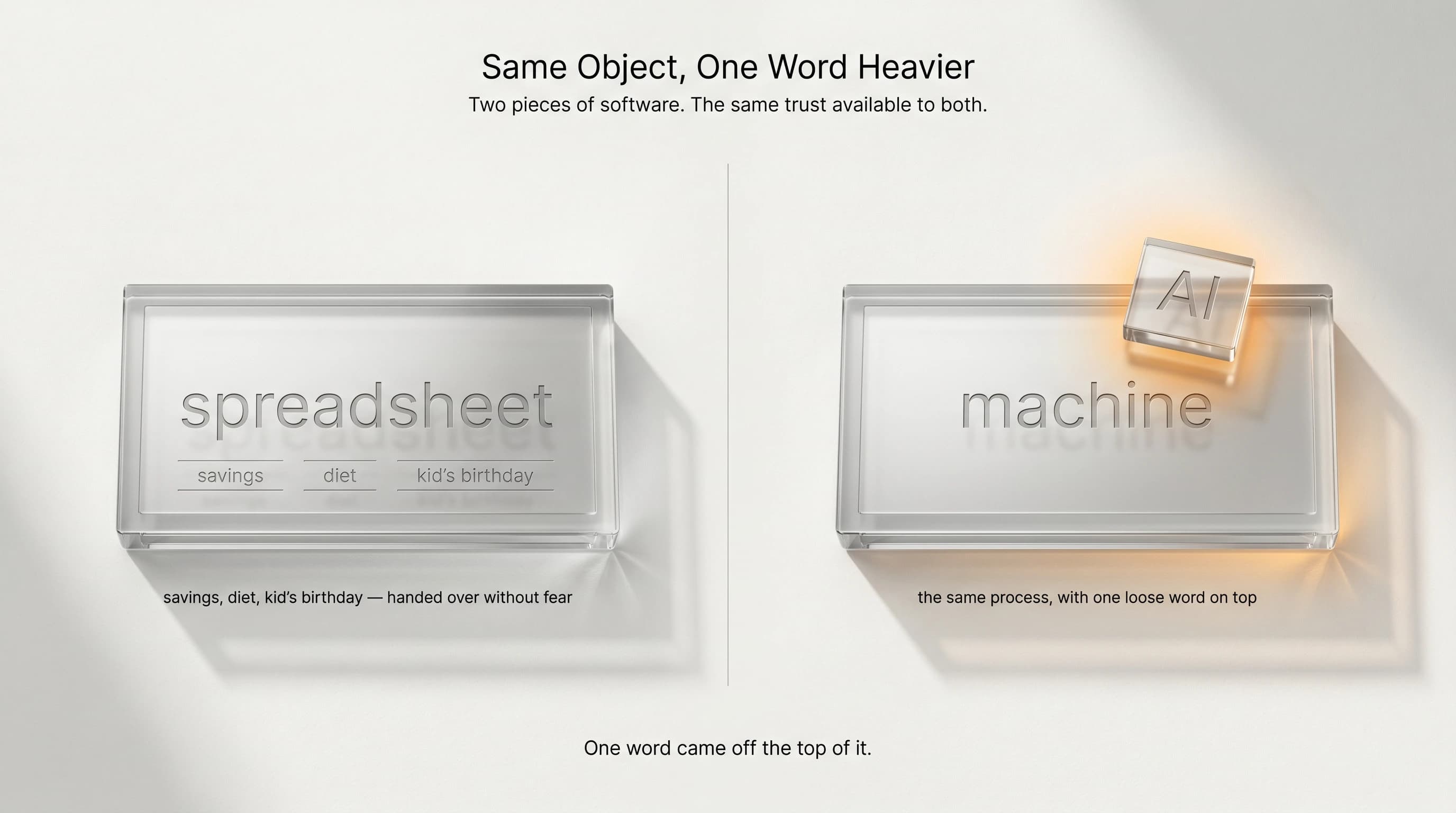
Here is the thing about that same friend. He has run his entire life out of a single spreadsheet for as long as anyone who knows him can remember. His savings are in there. His diet is in there. His kid's birthday is in there. He has handed that small grid of cells more of himself than he has handed most of the people in his life, and the spreadsheet has never once frightened him. He opens it every Sunday morning, coffee going cold at his elbow, and he is the calmest man you have ever seen.
It is software. It takes his input, runs a process on the most intimate facts of his existence, and hands a result back. By every honest description it is the same kind of object as the thing he is afraid of. And yet someone at that table only has to say the word "AI" and you can watch him change. He goes quiet. He goes still. Still the particular way you go still when you think you heard a noise downstairs and you are waiting to find out if you imagined it.
The gap between the spreadsheet and the machine is the whole story. Both are processes. Both take what he gives them and hand something back. One of them holds his life and never costs him a moment of sleep. The other he will not touch. The difference is not in the silicon, and it is not in what either thing actually does. It is in the noun.
I should tell you what I do, because it makes the next part a little embarrassing. I build these things for a living. The elastic automator I work on is the exact category of thing people are pointing at when they say the word AI. By rights I should be the friend who can talk him down. I cannot. I have sat across from him with every fact I own laid out on the table between us, and he is still scared by the time I leave.
So one day I stopped arguing and tried the obvious thing instead. I told him to sit down and just watch it work. I open it up right there at his kitchen table and I give it a real task, a fiddly one, the kind with enough moving parts that you cannot fake your way through it. It pauses for a second. It does the job. It hands the work back clean and quick. He is watching the whole time and he has not said a word.
Then I do the part that matters. I close it, and I open it again, completely fresh. New conversation, empty screen, and I ask it straight: who are you talking to? And it has nothing. Not my name. Not his. Not the task it finished sixty seconds ago. Everything that just happened at that table, to that thing, simply never happened. There is no file with his name on it, no grudge, no quiet resentment assembling itself in the dark. It ran a task and then it went dark, the way a calculator goes dark the moment you stop pressing keys.
"See," I tell him. "It doesn't keep you. It ran the task and it went dark." He looks at the screen. He looks at me. And he says, evenly, "yeah. That is exactly what it would want me to think." That was the day it finally landed for me, because his fear had just walked straight through a live demonstration of its own emptiness without breaking stride.
Here is what I had been getting wrong. He is not stupid for being scared. He is just scared of the wrong shape. He pictures a mind in there. A small one, a dim one for now, but a mind, and the fear is the obvious one that follows: small things grow up. He is afraid of a tiny intelligence on its way to becoming a larger one.
But it is not a small mind. It is not a mind at all. That is not an insult aimed at the machine, and it is not a measurement of how clever the machine happens to be. It is a statement about what category of thing it is. He has been searching, patiently and sincerely, for the wrong kind of thing.
In 1949, long before any of this, there was a philosopher at Oxford named Gilbert Ryle, and he had already found the exact shape of my friend's mistake. I want to be honest about the borrowing, because honesty is the whole point of using it. Ryle was not writing about machines. He could not have been. There were no machines like this for anyone to write about. He was arguing with Descartes, about people, about the human mind and an old picture of how it sits inside the body. But the tool he built in the middle of that argument travels, and it travels cleanly.
He explained it with a small story. Picture a visitor coming to Oxford for the day. You give him the full tour. The colleges, the libraries, the laboratories, the lawns, the dining halls, all of it. And at the end the visitor turns to you, perfectly polite, and asks: this has been wonderful, truly, but where is the University? He is not slow and he is not joking. He has simply assumed the University is one more building, one more stop you forgot to include, standing in a row beside the colleges. It is not. The University is not a building at all. It is the name for the way all of those buildings work together as one thing. It was never a stop on the tour. It is the shape the tour already had.
"Where is the mind inside the AI" is that visitor's question, word for word.
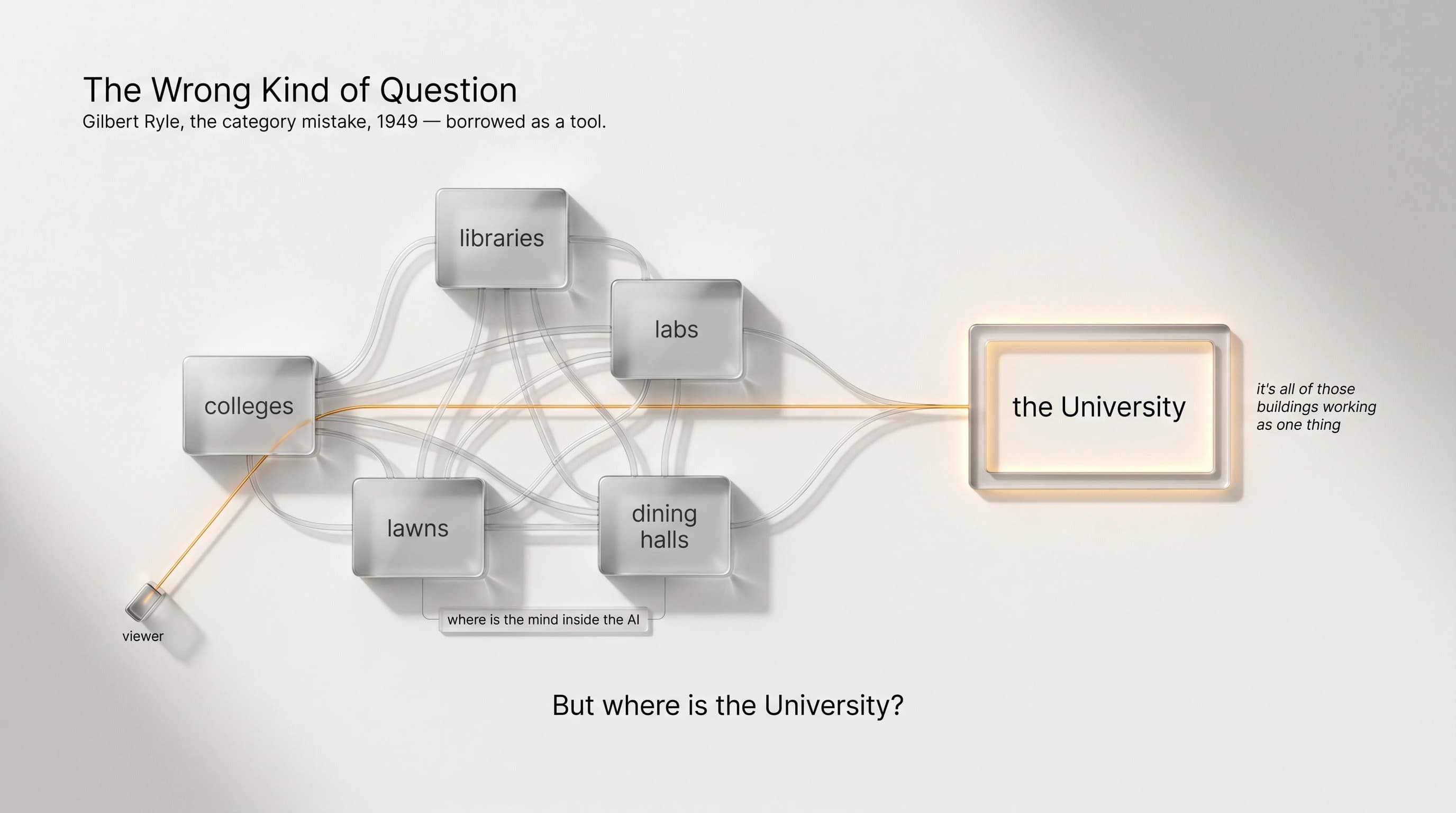
You can take the whole machine apart. You can search every corner of it. You will not find a small room with a small mind sitting inside, and not because the mind is too well hidden or too faint to register. A mind was simply never the kind of thing it is. The word AI sent my friend walking down a corridor with no door at the end of it, and then it left him standing there in the dark, frightened of what he could not find.
So here is how it actually ends, because it does end, and it ends quietly. Same friend, same kitchen, same Sunday morning. Same coffee going cold beside him. Same machine sitting open on the table.
Only this time I do not say the word AI, and I do not reach for anything clever. I just tell him plainly what the thing is. You give it a task and it runs. It is quick, and it hands the work back, and you check it. That is the whole animal. The name I use for a thing shaped like that is an elastic automator, though he did not need that name either. He needed the plain description, and the plain description has no ghost standing in it for him to fear.
And he listens, and he shrugs, and he uses it. Coffee in hand, the same easy calm he has always given the spreadsheet. Nothing about that machine changed between the evening he was afraid of it and the morning he was not. Not one wire. Not one line of it. The only thing that moved was a single word, and the word came off the top of the machine the way a label peels off a jar.
His fear was real, and it was reasonable, and it was never actually about the machine. It was about a sentence somebody handed him, and one word inside that sentence told him to go hunting for a mind. The ghost was never in the machine. It was in the sentence.
Loading comments…