


The Patterns I Stopped Doing by Hand
- repositoryallemaar (2026). open-skills — read any skill, then run it
- repositoryYounndAI (2026). YON — the language the instructions are written in
- repositoryYounndAI (2026).
We use cookies to understand how you use this site and improve your experience.
There is a task on my desk I have done a hundred times. Same shape every time. I open the thing, I check the same five places, I fix the same small problem, I close it. Then next week, there it is again, waiting for me like it never left.
You know this feeling. Everyone who works knows this feeling. This is a story about that, and about where it quietly took me.
Most of what we call work is not the big project. It is the small jobs that come around again and again. Tuesday looks a lot like last Tuesday. There is the report, the cleanup, the follow-up. There is the thing you always forget until you are halfway through it.
For years I just did them. By hand. Again and again. I told myself it was fine, because each one was small, and small things do not feel worth fixing. But they add up. It was time, leaking out one drop at a time. A drop does not look like much. A year of drops is a different story.
The strange thing is that I already knew the right way to do each of these. I had done them enough times to know the good version cold. The way I would do it on a calm morning instead of a rushed afternoon. I just did not always have a calm morning.
So at some point I stopped. Not stopped working. Stopped doing them by hand.
For each of those tasks, I sat down once and solved it properly. The good version, the one I would be proud of, not the corner-cutting version I fall into when I am tired. The real one.
Then I did the part that mattered. I wrote it down. Not a loose note. Not a sticky on the monitor that I would lose by Friday. I wrote down the exact steps, in order, the way you would write a recipe for someone who has never stood in your kitchen.
I had a reason to be that careful. I have agents working alongside me now, helpers that can carry a task while I do something else. I wanted them to run my solution exactly the way I would. Not roughly. Not close enough. Exactly.
That exactness turned out to be hard. Give a machine a vague instruction and you get a vague result. If I write "tidy this up," it has to guess what I mean. Sometimes the guess is fine. Sometimes I am cleaning up after the cleanup.
I did not want guessing. And wanting my way, every single time, sent me somewhere I did not plan to go.
So I started pulling at the question of why. How does a sentence actually carry what a person means. We say words and assume they arrive whole, but they do not always. The same instruction can land one way in my head and a slightly different way somewhere else, and that small gap is where the wrong result is born. I wanted to know exactly where the gap opens.
I started watching how these machine-minds read an instruction, and where they quietly drift off course. It is rarely dramatic. It is a small lean, a word taken a shade differently than I meant, and then the work tips with it. I wanted to know what makes a line land the same way twice instead of three different ways on three different days. What it is about some sentences that pins them down, and what it is about others that leaves room for guessing.
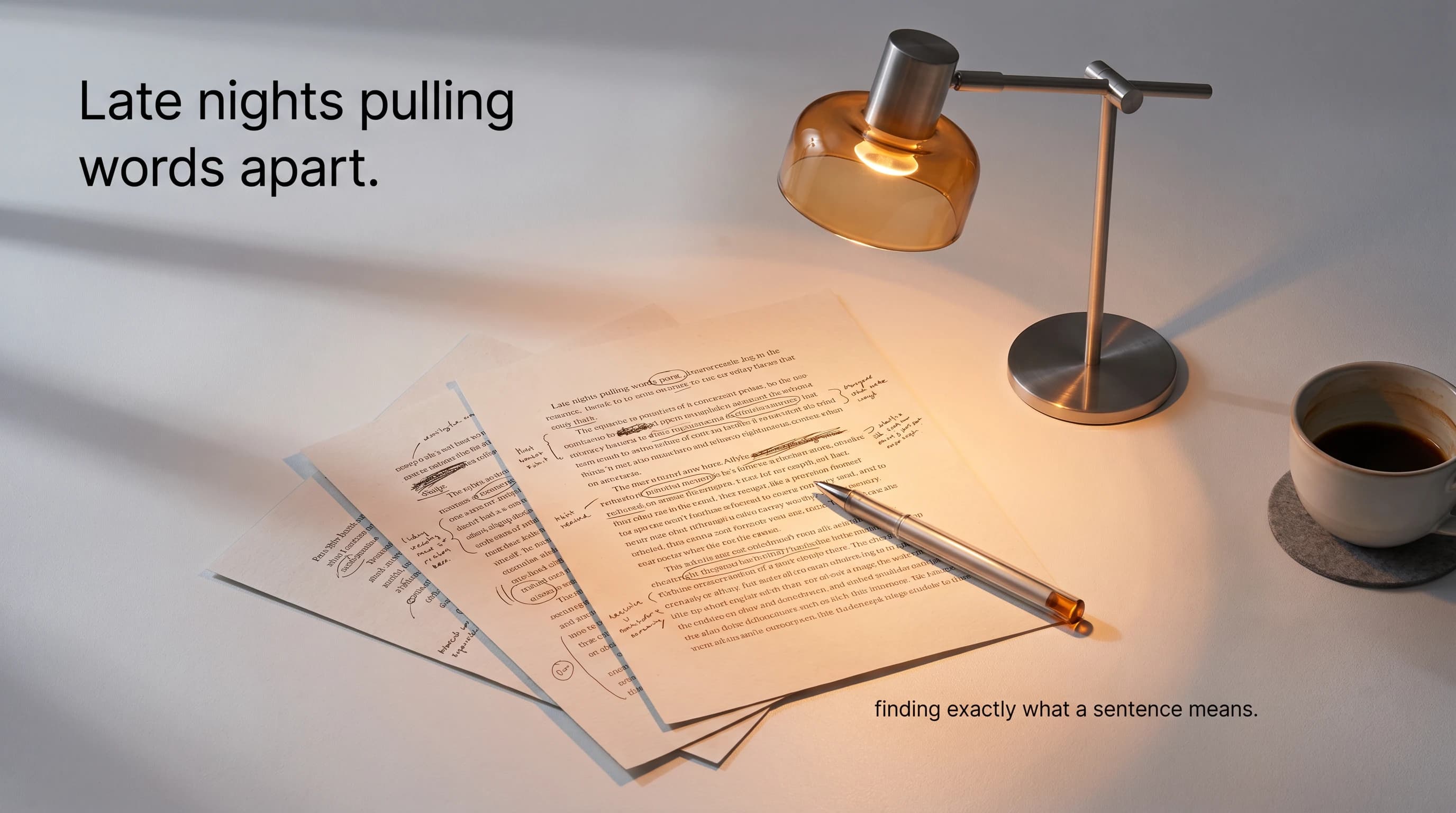
It became a bit of an obsession, if I am honest. Months of it. Late nights spent taking words apart and asking how meaning even survives the trip from my head to the work getting done. I would sit with a single instruction and rewrite it five ways, watching which version held and which one slipped, the way you might worry at a knot until you finally see how it is tied. The small relief of fixing a Tuesday chore had quietly turned into something much larger and stranger. A real pull I did not see coming, and could not put down.
And out of all that digging, a way of writing the instructions came. It did not arrive in one piece. It grew out of the need and out of the patterns I kept solving, but just as much out of the questions, the late nights, the slow work of learning where meaning leaks and how to seal it. A special language. It is called YON. That is the one new word in this whole story, and it earned its place, because it is the thing that holds everything else together.
YON is what lets the instructions be precise. It pins down what I mean so nothing gets lost in translation between my head and the task getting done. The good version stays the good version, on a Tuesday I am not even looking at. That is the quiet promise of writing something down properly. It keeps its shape when you walk away.
What I love most about them is this. You can read them. Every single one. You can open any of these and see exactly what it tells my agents to do, step by step, in plain words. No black box, no hidden machinery you have to trust on faith. If you want to know what one of these does before you let it near your work, you read it. It is all right there.
That matters more than it sounds. A lot of automation asks you to trust a thing you cannot see inside. This is the opposite. The instruction is the whole truth of what happens. If it does something, it says so, in language you can follow.
Each one of these gets checked. Quietly, in the background. If I break one, if I leave a step half finished, the check catches it. A broken one cannot quietly slip through and start doing the wrong thing in my name.
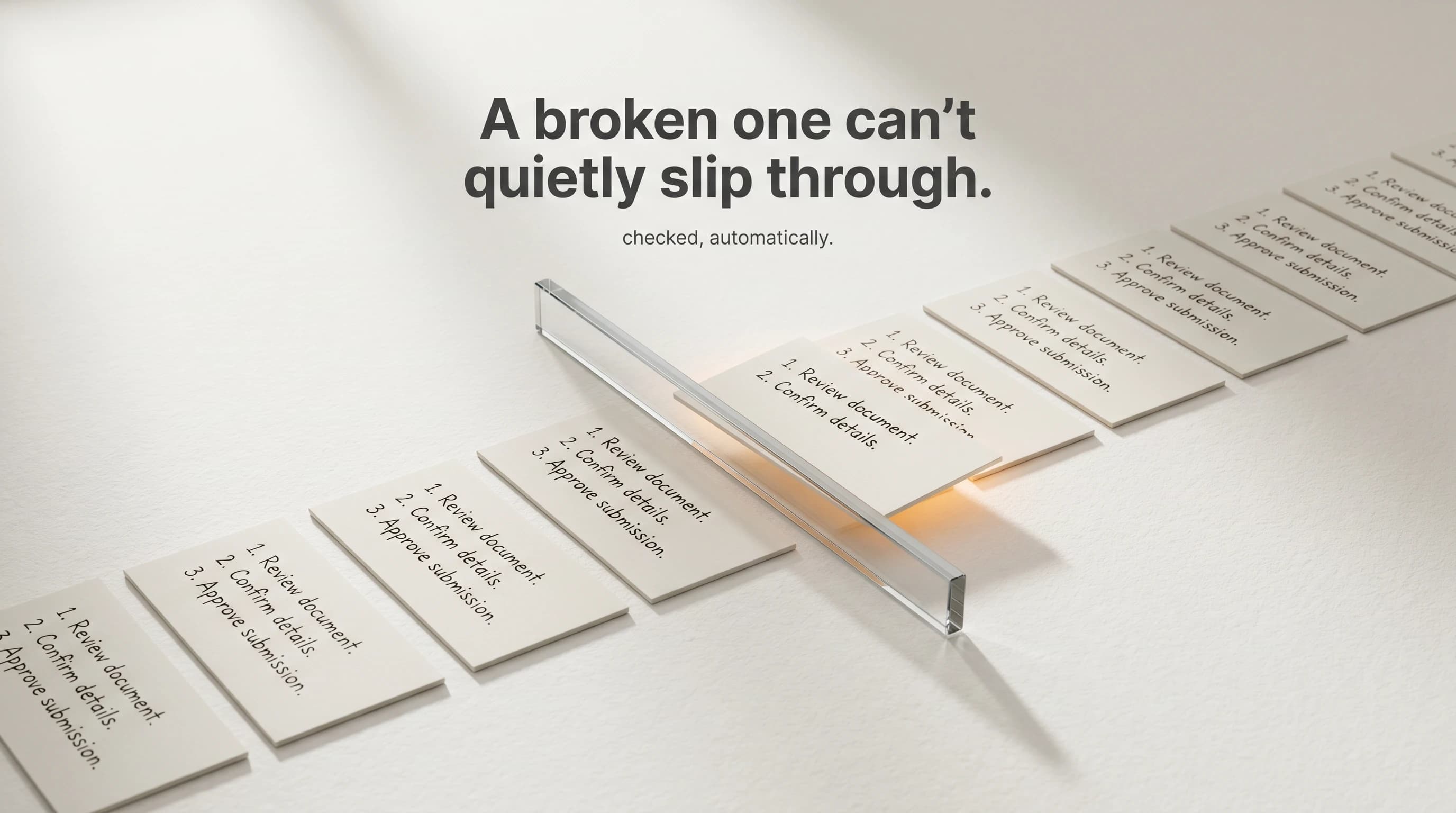
This morning, one of my own checks looked at my own work and told me no. It rejected it. Something I had changed did not meet the standard I had set for myself, and the check would not let it pass.
And I was glad. Genuinely glad. A standard that only applies when it is convenient is not a standard. The fact that it stops me, the person who wrote it, is exactly why I trust it to stop a mistake.
I never built any of these to sell anything. I built them for me, to get my own time back, to stop spending my best attention on jobs that did not deserve it. That is the honest origin, and it is the only reason I trust them enough to show you. They have been earning their place in my own week for a long time.
So that is what I am doing. I am opening up the whole collection. Dozens of them. The patterns I stopped doing by hand. Take any of them and use it. Read it first. See what it does. Then let it carry the task you keep redoing.
Find the thing you do every week. The one you sigh before starting, the one that is not hard, just relentless. Solve it once, the careful way, the way you would be proud of. Write it down so it is exact, exact enough that something else could run it without guessing. And then let it run.
The work was never the problem. Doing it by hand was.
Loading comments…