



Elastic Automators: Why Most "AI" Is Not Intelligence
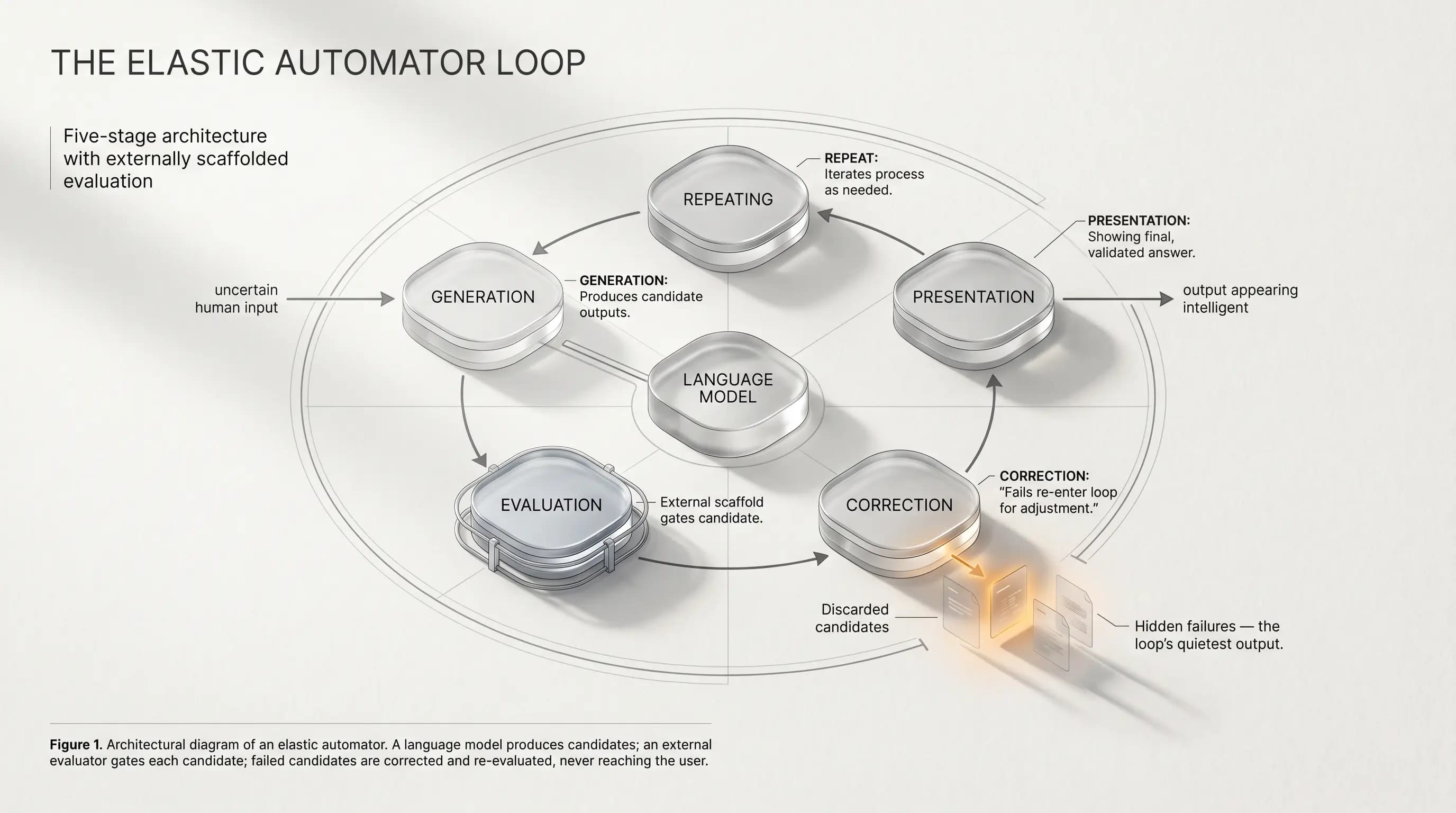
- paperAlexandru Mares (2026). Elastic Automators: A Diagnostic Vocabulary for Language-Model-Driven Workflow Systems
We use cookies to understand how you use this site and improve your experience.
We did not create artificial minds. We made automation flexible enough to look conversational. That may be the real technological shift hiding under the wrong name.
We keep calling it artificial intelligence because the phrase is already there. It is useful. It is dramatic. It sells. It gives investors, companies, journalists, and users a single word for a large cluster of systems that appear to do things only intelligent beings used to do. But the name is misleading. Much of what we call AI today is not intelligence in the human sense. It is not a mind forming intentions, revising beliefs, or understanding the world from inside experience. Much of it is better described as elastic automation.
Traditional automation was rigid. A rule fired when a condition was met. A script followed predefined branches. A workflow moved from step to step, but only inside the shape its designer had already imagined. Language models changed that shape. They gave automation a flexible interface to natural language. They allowed software to interpret messy input, rewrite instructions, classify intent, call tools, summarize results, retry failed steps, and present a response that feels coherent to a human reader.
The workflow became less brittle. The pattern became softer. The machine did not become a mind. The automation became elastic.
An elastic automator is a system that uses a language model.
It turns uncertain human input into executable structure.
Then it loops through generation, evaluation, correction, and presentation until the output appears intelligent.
That distinction matters. Because if we mistake elastic automation for intelligence, we will design around the wrong object. We will ask whether the system "knows," "wants," "understands," or "decides," when the more practical question is often simpler. What loop is running. What tools can it call. What memory does it retrieve. What criteria does it optimize. What failures does it hide before showing the final answer.
The illusion of intelligence does not come from nothing. These systems are powerful. They can produce useful work, discover patterns, compress knowledge, write code, coordinate tools, and adapt across tasks in ways older automation could not. But power is not the same as mind. Elastic automation is not a downgrade. It may actually be the more precise achievement.
We did not create artificial minds. We made automation flexible enough to negotiate language.
That deserves a precise name.
Not artificial intelligence. Elastic automation.
The systems are not minds. They are elastic automators.
Loading comments…