


What the Phone Did to Work
- paperAlexandru Mares (2026). Elastic Automators: A Diagnostic Vocabulary for Language-Model-Driven Workflow Systems
- essayAlexandru Mares (2026). What Notation Did to History
We use cookies to understand how you use this site and improve your experience.
Today the trope is back on every feed. The one that says AI won't take your job, but someone who understands AI will. It rotates back into circulation every quarter, slightly reworded, attributed to a fresh name each time. The displacement question keeps getting asked.
It already has an answer. The phone era ran the experiment for twelve years and finished it in 2014. The people who used the desk it absorbed are still working.
Picture a working desk in 2003. A calculator on the corner. A paper map folded in the top drawer. An alarm clock on the shelf. A point and shoot camera tucked next to the inbox. A Rolodex full of business cards. A landline with a coiled cord. Six objects, each indispensable to a different part of the day.
Between 2007 and 2014, the smartphone absorbed every object on that list. It also absorbed a few that weren't on the desk. Yellow Pages, which used to sit on top of every household phone book stand in the country. GPS units bolted to car dashboards. MP3 players in the gym bag. Point and shoot cameras as a category, not just the one on the desk. Landlines as a default in newly built homes.
Nobody wrote the think-piece. Nobody asked who understood the phone. Nobody became a phone whisperer. There was no LinkedIn quote cycling every quarter that said "the phone won't take your job, but someone who understands the phone will." The displacement was visible enough that the question never had to be asked.
The phone absorbed the desk into something everybody carried. The desk-users carried the phone instead of the desk, and kept working. That is the empirical record, twelve years old.
So when the same question cycles back around in a different vocabulary, the answer is sitting in plain sight. The trope's logic is that displacement happens through other people. A more capable colleague, armed with the new tool, takes the job the less capable colleague used to do. The phone era flatly disconfirms this. There was no class of phone-understanders who took the jobs of phone-non-understanders. The phone became the table stakes, and the desk dissolved underneath it.
The trope keeps asking who keeps the job. That isn't the question the phone era answered. The phone era answered a different one, and the answer is what to look for now.
The right question is the one nobody on a feed has asked yet.
What will be the next thing that does to our lives what the phone did.
That is the question this essay is going to sit with. Not answer. Sit with.
So what would this thing be.
It isn't another app. It isn't a chatbot. It isn't what we've been calling an LLM. It isn't an agent. It isn't an assistant.
Is it a mind, or something else entirely.
A mind has a body. This one wouldn't, exactly. It would have access to the body you already have. Your phone, your watch, your laptop, the room you work in, the room you sleep in. That access is not the body of the thing; it's the body of the person it grows with.
A mind has a history. This one would have your history. Or part of it. Or all of it. The history that ends up inside it is the part of your life that crossed paths with it long enough for it to remember.
These aren't tests with answers. They're the right shape of question for what's coming. The word "tool" doesn't fit it. The word "chatbot" doesn't fit it. The words we've been using don't fit. There's no word that fits yet.
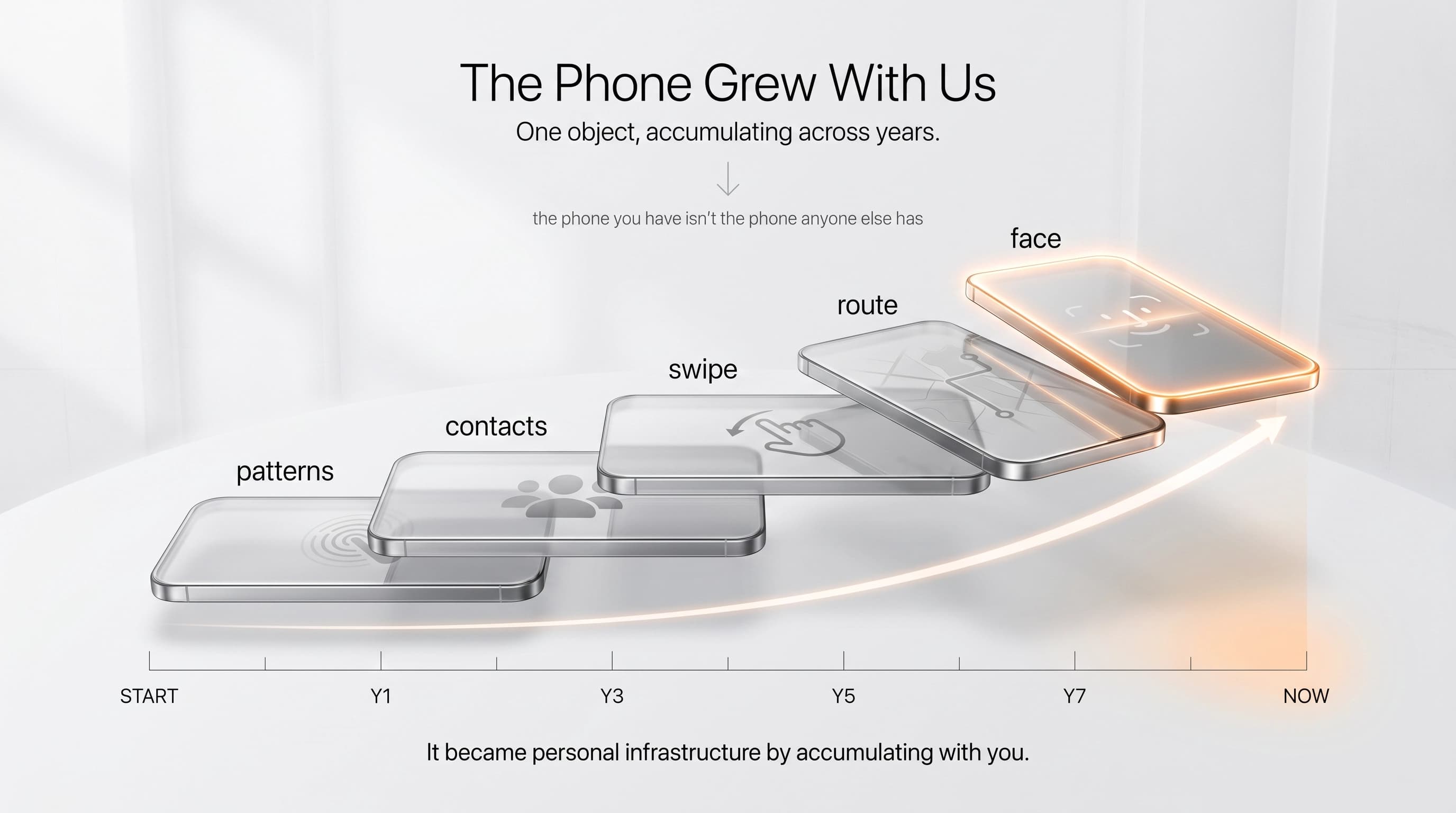
The phone grew with us. That's what nobody calls out, because we lived through it without noticing.
The first phone was a thing in a drawer. Then it was a thing in a pocket. Then it was a thing on a desk, in a kitchen, in a school bag, in a hospital room. The hardware changed. The software changed. The screen got bigger and then smaller and then bigger again. But the more interesting change was quieter. The phone learned your patterns. Your contacts. The way you swipe. The route you take. The face that unlocks it. The apps you open before coffee and the ones you open after midnight.
The phone you have isn't the phone anyone else has. It became personal infrastructure by accumulating with you.
Whatever comes next will have to do that too.
Something that grows alongside you, across years, not sessions. Remembers you between conversations. Knows the difference between a task and a bond. Knows when to help, when to stay silent, when to refuse, when to protect. Knows your family isn't your colleagues. Knows your private interiors are not your public work.
The accumulation is the load-bearing property. Not capability. Not speed. Not parameter count. The thing that compounds, slowly, into something irreducibly yours.
We don't have a name for that thing. Not really.
The question at the start is the one to keep.
What will be the next thing that does to our lives what the phone did.
It won't be the phone, made smarter. It won't be a chatbot, made warmer. It won't be an agent, made more capable. Those are the moves the trope's vocabulary makes available, and the trope's vocabulary is exactly what the phone era proved insufficient.
It will be something that grows with one person at a time. Something that holds the part of your life the phone never could.
And we don't have the word for it yet.
The think-piece that wasn't written in 2014 was the one that would have noticed the phone wasn't the story. The story was the desk. The phone was the visible event; the desk dissolving was the invisible consequence. The think-piece being written every week now is the same kind of misdirection. The visible event is the trope. The invisible consequence is the question nobody has put on the feed yet, the one that's been sitting underneath the displacement question all along.
Loading comments…