



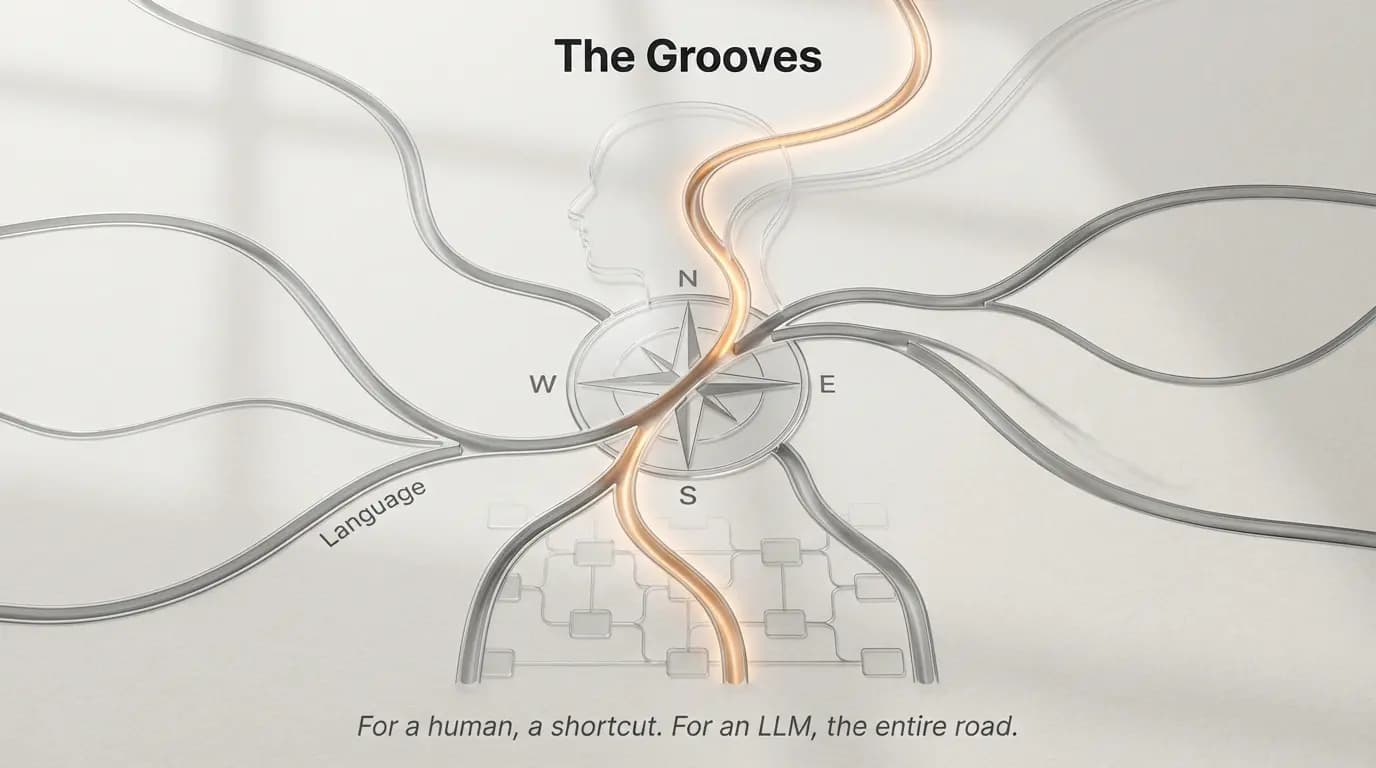
The Grooves
We use cookies to understand how you use this site and improve your experience.
There's a community in Australia that doesn't use left or right. They use north, south, east, west. For everything. Pass the cup to the northwest. The ant is on your southern leg. And they never get lost.
The Guugu Yimithirr people. North Queensland. Their language has no words for left and right. Instead, they developed a capability most of us don't have. A running internal compass. Always on. Always accurate. Not because they're born different. Because their language required it. Every sentence demands orientation.
And there's a lab result that sharpens this. Winawer, 2007. Russian has two separate words for light blue and dark blue. Goluboy and siniy. Not shades. Different categories. Russian speakers categorize those blues faster than English speakers. Same eyes. Different grooves.
Grooves. That's the right word for what language does to thought.
Not walls. You can think outside your language. Humans do it constantly. Gut feelings, spatial reasoning, the inarticulate hunch you can't put into words yet. Language doesn't trap you. But it carves channels. Default pathways. The directions thought flows through when you're not fighting against it.
The Guugu Yimithirr don't have superhuman orientation. They have a language that carved a groove so deep that spatial awareness became automatic. Russian speakers don't have better eyes. They have a vocabulary that carved a groove between two blues.
Now. For a human, the groove is a shortcut. For an LLM, the groove is the entire road.
Humans have thinking outside language. You can feel something before you can name it. You reason spatially, emotionally, physically. Language shapes your thought, but it doesn't contain it.
An LLM has no gut feeling. No spatial sense. No prelinguistic cognition. Its reasoning is token prediction. Start to finish. The input is not shaping a deeper process. The input is the process. There is no thinking outside the notation.
Which means the format you write in doesn't just influence how the model reasons. It defines the boundaries of where reasoning can go. The grooves in the notation become the grooves in the thinking. Not the easy path. The only path.
Last video, the context window was the mind. This is the next piece. The notation filling that window is the architecture of the mind. Every field name, every indentation pattern, every structural choice. Grooves.
You're not picking a data format. You're laying down the tracks that thought will run on.
Loading comments…