



The Extended Mind
We use cookies to understand how you use this site and improve your experience.
An AI doesn't think about what you give it. What you give it IS its thinking.
Let me tell you about Otto.
In 1998, two philosophers asked a question. Andy Clark. David Chalmers. Simple question, radical implications.
Otto can't form new memories. So he carries a notebook. Everywhere. Addresses, directions, plans. All written down. One day he wants to visit a museum. He opens the notebook. Reads the address. Goes.
Now, Inga. She just remembers the address. She thinks about the museum, the location surfaces, she goes.
Clark and Chalmers said: both of them know where the museum is. The notebook isn't a tool Otto uses. It's part of his mind. His memory doesn't stop where his brain stops.
So what does a philosopher's question about a notebook have to do with AI?
Everything. Because for an LLM, the thesis isn't a metaphor. It's literal.
An LLM has no persistent memory. Between requests, it retains nothing. Zero. Its entire mind, everything it can know, everything it can reason about, is the context window. That's it. The weights give it capabilities. Language, patterns, logic. But what it knows right now, what it can think about right now, is whatever sits inside that window.
The context window isn't input to the mind. It IS the mind.
But here's the part most people miss. It's not that the notebook exists. It's how the notebook is organized.
If Otto's notebook were chaos, random scrawls, no order, pages falling out, it wouldn't work as a mind. He'd have a notebook and still not know where the museum is. The structure of the notebook is what makes it cognitive. Not the paper. The organization.
Same with a context window. You can fill it. That's easy. Anyone can dump text into a prompt. But filling it isn't the same as building with it. A cluttered context window is a cluttered mind. A structured context window is a mind that can see, connect, reason.
If you dump unstructured garbage into a context window, you didn't give it bad input. You gave it brain damage.
The format you use determines what the model can hold in its head at once. Verbose format takes up space. The model sees less. Dense, clean format says the same thing in fewer tokens. The model holds more relationships. Connects more dots. Thinks across more of the system.
You're not saving tokens. You're expanding the mind.
Clark and Chalmers wrote about humans and notebooks. For AI, there is no skull. There is no brain behind the window. The window is everything.
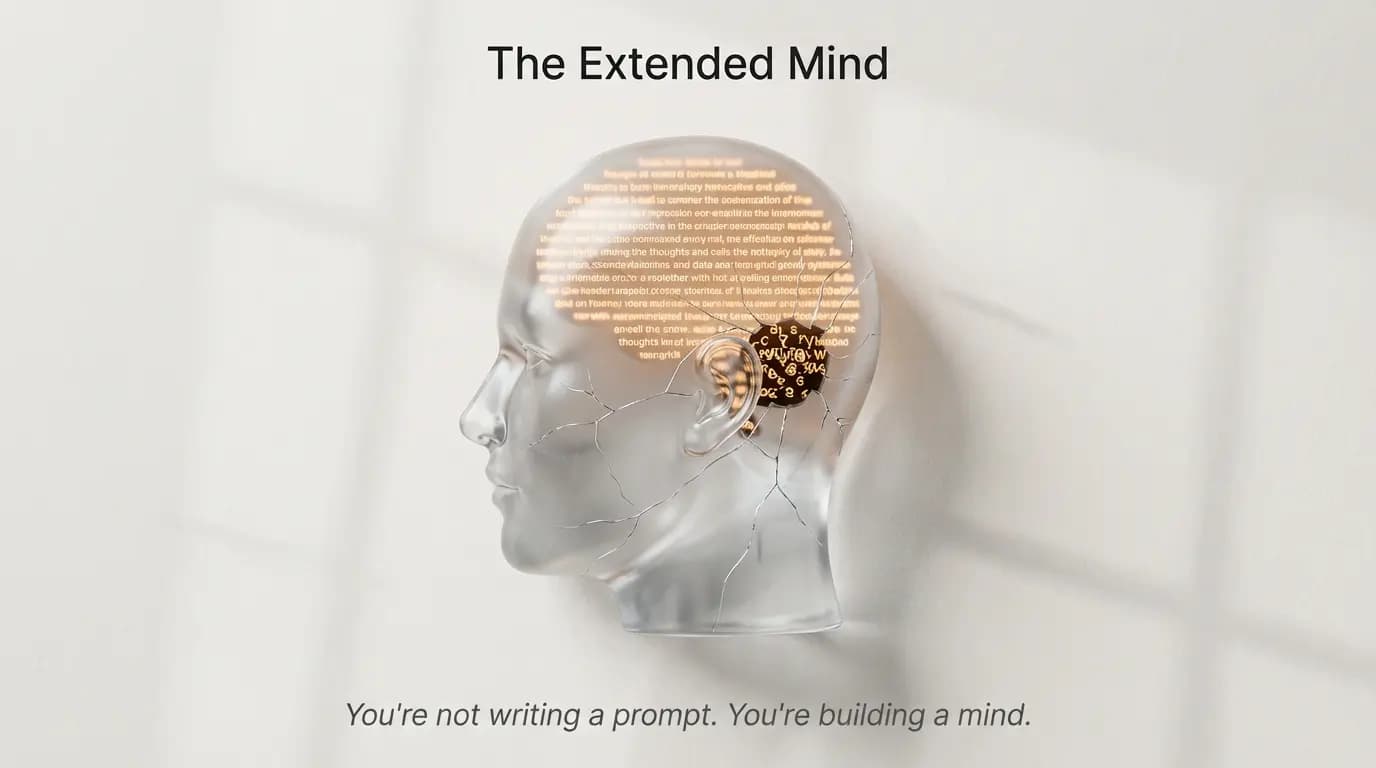
You're not writing a prompt. You're building a mind.
Structure before scale.
Loading comments…