


Second Brain, No Thought
We use cookies to understand how you use this site and improve your experience.
Your second brain has never had a single thought.
You have a vault. Hundreds of notes. Tagged, linked, searchable. An AI plugin that finds anything in seconds.
Then someone asks what you actually think. You search. Find the note. Read it back.
And somewhere in that moment, you mistake finding for thinking.
The note was exactly where you left it. Unchanged. And so were you.
Here is what thinking actually looks like.
You go looking for something — not because you were told to, but because something is bothering you. You find something that contradicts what you believed. You sit with it. Push back. And you come out the other side different from when you went in.
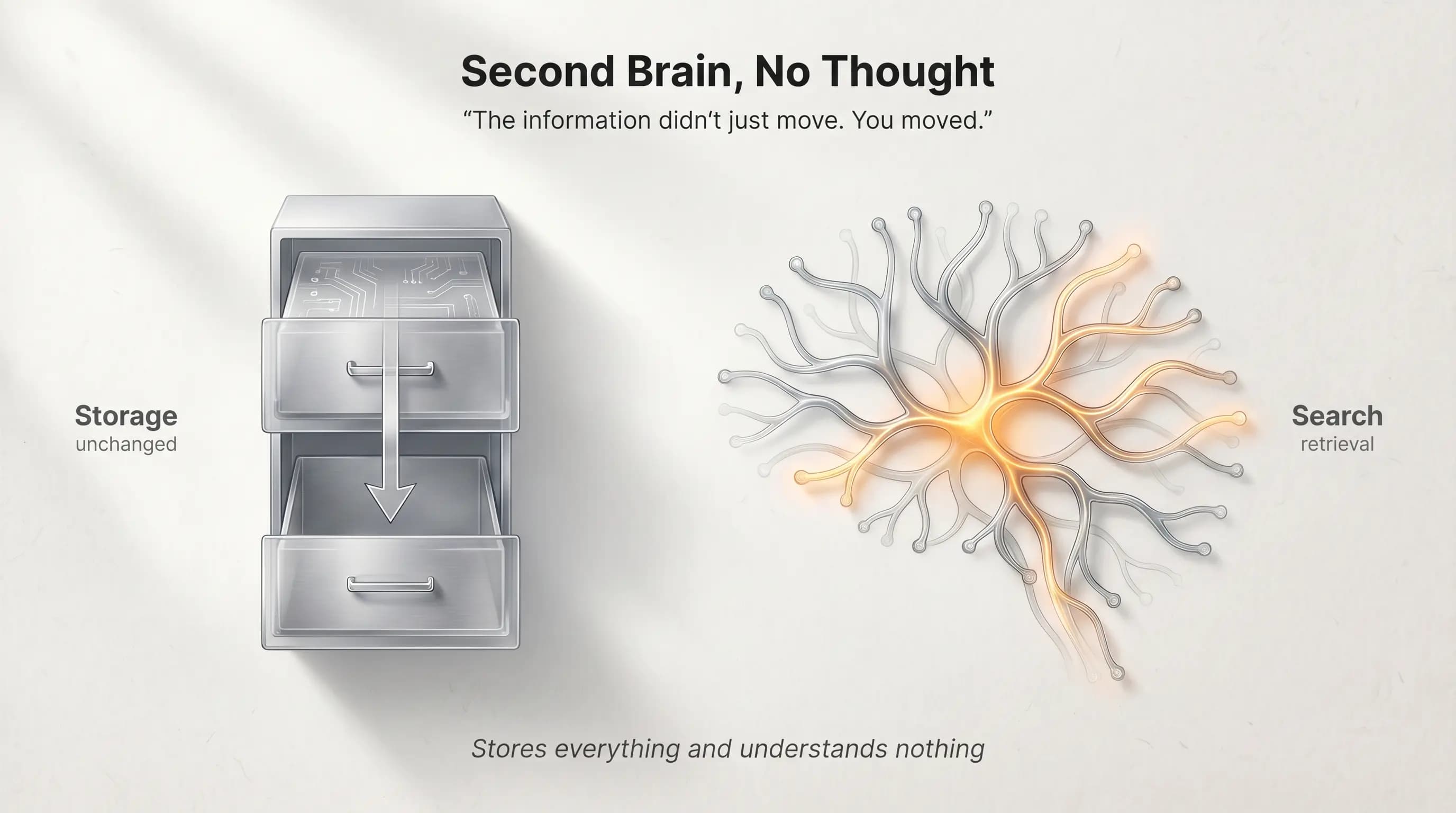
The information didn't just move. You moved.
Retrieval gives you back what you stored. Thought changes what you have.
In 1998, Andy Clark and David Chalmers argued that tools can genuinely extend the mind. But they had one condition: the tool has to be actively coupled to your thinking. Shaping what you notice. What you expect. What you reach for next.
Your vault does not do that. It does not anticipate. It does not notice you have been circling the same question for three months. It stores every note at the same weight, unchanged, until you come back for it.
A filing cabinet with a search bar. It stores everything and understands nothing.
So here is what your second brain cannot tell you.
The thinking was always yours. Before the search and after it. The tool held the paper.
Right now, watching this, you are doing something your second brain cannot do. You are actively seeking. Filtering through your own worldview. And you will come out of this different from when you started.
The difference between a library and a mind was never the index. It was always you.
Loading comments…