



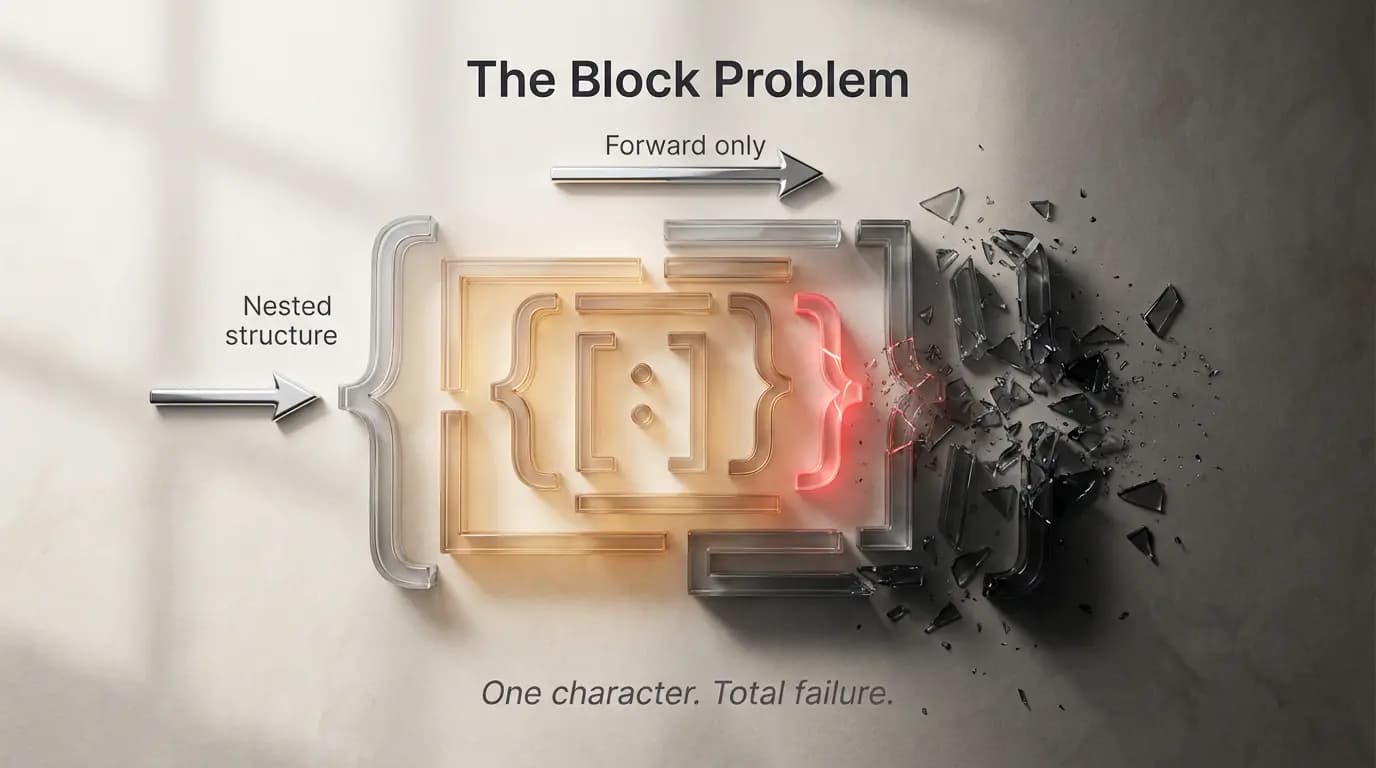
The Block Problem
We use cookies to understand how you use this site and improve your experience.
Imagine writing an entire essay, but you can never re-read what you already wrote. You pick the next word. Commit. Move on. No backspace. No scrolling up. Just forward.
That's how every large language model works. One word at a time. It picks the most likely next word, locks it in, and moves on. It never looks back. It never peeks ahead. Forward only.
Now here's what we ask it to do. We tell it: give me structured data. A list of users, their names, their emails. Something a computer can read.
So we hand it JSON. Curly braces, square brackets, colons, commas, all nested inside each other. You open a bracket at the top. It has to close at the bottom. You open an array inside an object inside another object, and the model has to remember all of that. While generating one word at a time. Forward only. Never looking back.
We're asking a system that can only move forward to produce a structure that only makes sense as a finished whole.
And here's where it breaks. Not partly breaks. Completely breaks.
If one bracket is wrong. One comma out of place. The entire document is invalid. Not just that line. Everything. Every other field that was perfectly fine. Gone. Your parser can't read any of it.
Now put that in a pipeline where AI is talking to AI. Agent one sends a response to agent two, which sends it to agent three. One malformed bracket in that chain and everything downstream stops.
One character. Total failure. That's the architecture we built the entire AI industry on top of.
So here's the question I kept coming back to. What if there was nothing to break?
What if every line was complete on its own? Line six is bad. Lines one through five were already valid. Lines seven through ten are still fine. No nesting. No brackets to match. No state to track. Each line is a whole thought.
A format where the shape of the data matches the shape of the thinking. Forward only. One line at a time.
I've been working on this. A notation designed from scratch for how AI actually generates. It's called YON. I'll do a proper walkthrough soon. But the idea starts here. With this mismatch.
Structure before scale.
Loading comments…