


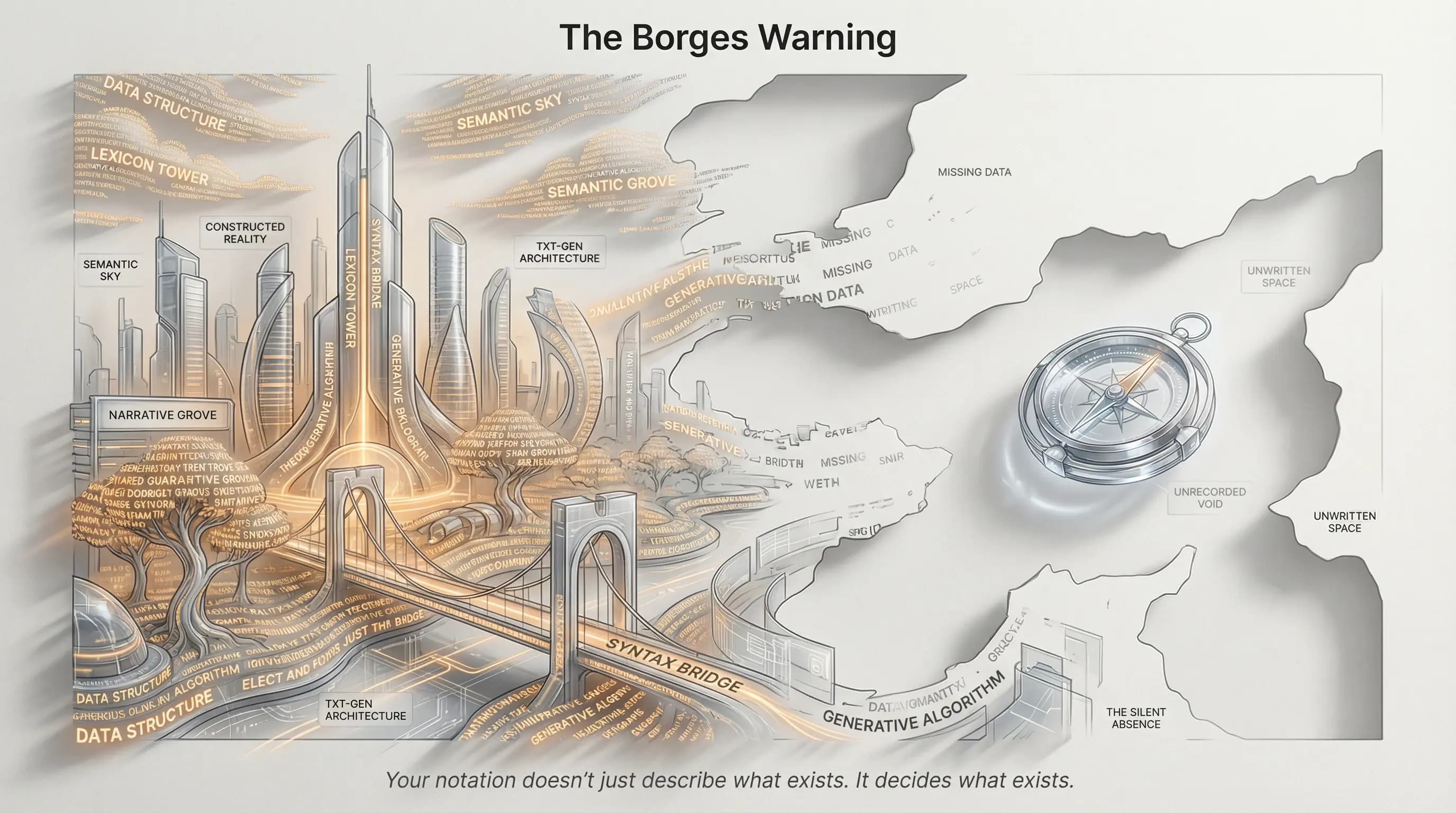
The Borges Warning
We use cookies to understand how you use this site and improve your experience.
The language you give an AI decides what it can think. What it can't think... doesn't exist.
A writer named Borges imagined a world called Tlon. In Tlon, the language has no nouns. None. Only verbs and adjectives. So instead of 'the moon rose,' the people of Tlon say something like...
Upward behind the onstreaming it mooned.
That's their way of saying 'the moon rose.'
It's not a table, it's 'tabling.' The object doesn't persist. The process does. And because the language has no nouns, the people who speak it cannot conceive of permanent objects. Not that they choose not to. They can't. The language won't let them.
Then comes the twist. Objects from Tlon start appearing in the real world. A compass made of metal that doesn't exist on Earth. A constructed language begins reshaping actual reality.
That's not poetry. That's engineering.
Every AI reads the world through a notation. If the notation has no word for something, the AI can't see it.
Think about that. If your notation can say 'must' but has no word for 'probably,' the AI lives in a world without doubt. If it includes rules but has no way to express performance characteristics, performance is invisible. The AI builds a world from whatever the notation provides.
Your notation doesn't just describe what exists. It decides what exists.
The gaps aren't bugs. They're blind spots baked into the notation.
Borges was warning us. Constructed languages don't just describe worlds. They bring worlds into being.
If you're designing notation for AI, you're not choosing syntax. You're choosing what the AI can see. What it treats as real. And what simply doesn't exist in its world.
Borges wrote this as fiction. We're building it as infrastructure.
Loading comments…