


The AI That Writes Like Everyone and No One
We use cookies to understand how you use this site and improve your experience.
You read something last week that no human wrote. You didn't pause. You didn't notice. And that's the part worth thinking about. Not that the machine produced it. That you couldn't tell. That the absence of a person behind the words didn't register as absence at all.
There's a question people keep asking about AI-generated text: who wrote this? Entire industries are being built around that question. Detection tools. Watermarking systems. Forensic classifiers trained to sort human from machine. But the question has a problem. It assumes there's a who to find. And with AI, there isn't.
In 1967, a French literary critic named Roland Barthes published a short essay called "The Death of the Author." Seven pages. His argument was that the meaning of a text doesn't come from the person who wrote it. It comes from the reader. The author, Barthes said, is not the origin. The text is a tissue of quotations drawn from innumerable centers of culture. He was making a philosophical argument. A metaphor. The author wasn't literally dead. Barthes was saying: stop looking for the person behind the words. The words are enough.
Fifty-eight years later, a language model writes a paragraph and there is no person behind the words. Not metaphorically. Literally. Barthes wrote his essay to liberate the reader. He never imagined a machine that would make his metaphor come true.
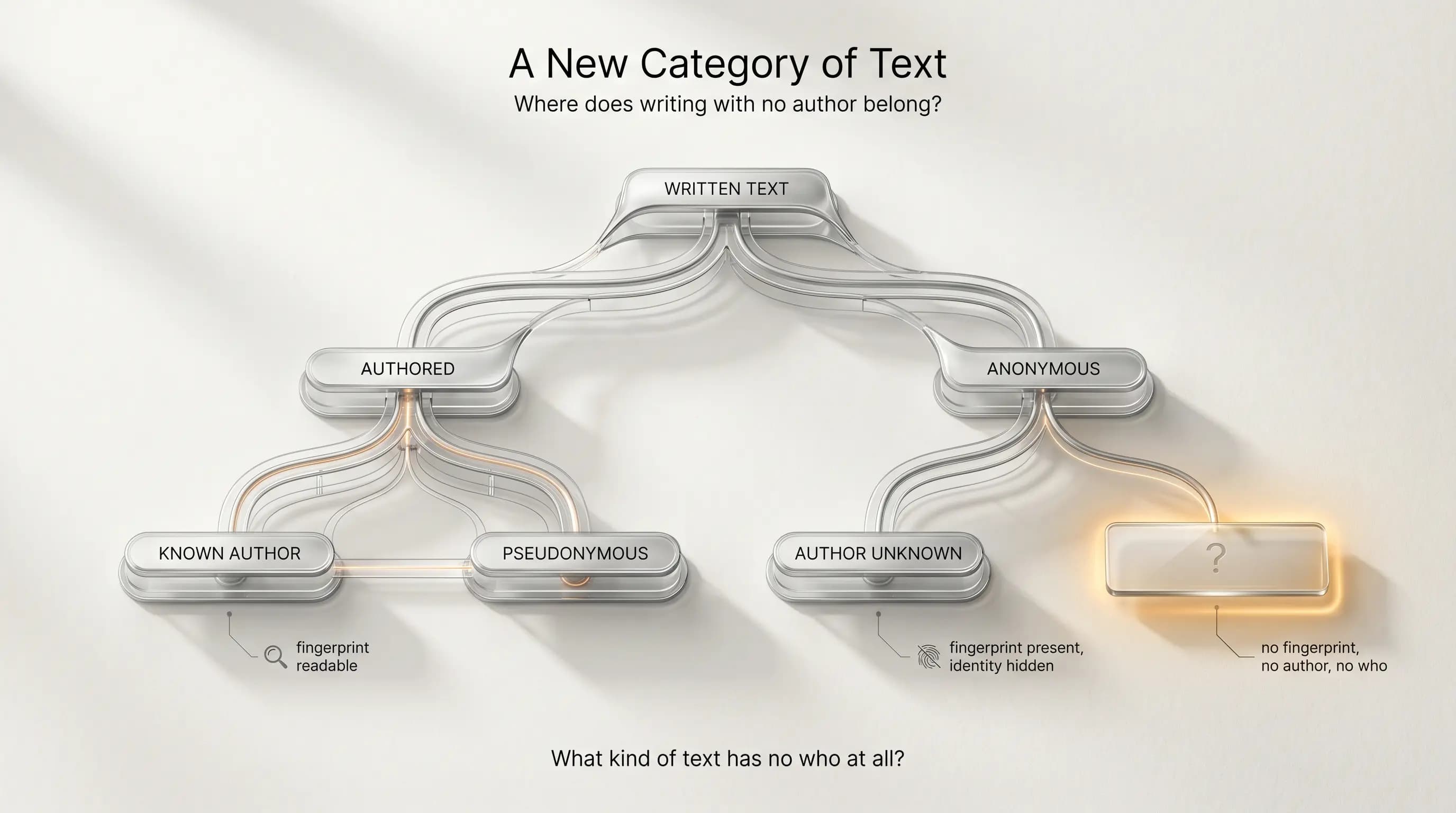
Here's where the detection conversation gets interesting. Forensic linguists have spent decades identifying authors by their quirks. The way someone overuses a particular word. Their sentence rhythm. The odd comma habit they can't shake. Human writing carries traces of a body and a mind. Fatigue shapes your syntax. Attention fluctuates and leaves traces. Every human writer has a shape, and that shape is readable.
AI doesn't have a shape. It has every shape averaged together. Stylometric research in 2025 and 2026 suggests a consistent pattern: AI-generated text tends toward greater regularity and less individual variation, especially in the small structural features of language. The little words, the, of, and, in, that humans scatter with personal quirks, AI tends to distribute with eerie evenness. Not wrong. Just flat. The fingerprint isn't forged. There is no fingerprint.
So the question shifts. Not "who wrote this?" but "what kind of text has no who at all?" That's a different question. It's not just a detection problem. It's an ontology problem. We've spent centuries assuming that text comes from someone. That writing carries authorship the way a painting carries brushstrokes. But a painting made by a machine that learned from every painter doesn't have brushstrokes. It has a statistical echo of all brushstrokes. And that's a new kind of object.
Michel Foucault, two years after Barthes, asked a sharper question: what does it matter who is speaking? He argued that authorship is a social function, not a natural property. Texts didn't always need authors. Anonymity was once sufficient. The author function, Foucault said, is something we impose on texts to control how they circulate. AI-generated text doesn't just lack an author. It sits outside the author function entirely. It circulates, it persuades, it informs. Institutions stand behind it, but there is no author to hold accountable for it. Not in the way Foucault meant.
That's the challenge sitting underneath the detection debate. The question isn't only whether we can tell human from machine. It's what happens to language when the category of authorship no longer applies. When text has no who. When writing exists without a writer. Not as a philosophical experiment, but as a billion words a day, accumulating quietly, looking like everything and sounding like no one.
Loading comments…